
Military calisthenics is the physical training backbone of armed forces around the world. From the US Army and Royal Marines to the French Foreign Legion and Israeli Defense Forces, military organisations rely on bodyweight exercise because it builds functional strength, cardiovascular endurance, explosive power, core stability, and mental toughness — without a single piece of equipment.
Civilian fitness has been catching up. Military calisthenics workouts have become one of the fastest-growing training approaches outside the armed forces — driven by the recognition that bodyweight training done at military intensity produces elite-level results that most gym programmes cannot match.
This guide covers what military calisthenics is, why it works, the core exercises with full technique cues, a complete 4-week training programme, and how to progress from beginner to warrior-level fitness.
⚕️ Medical Disclaimer: This article is for informational purposes only. Consult a GP or physiotherapist before beginning a new high-intensity training programme, particularly if you have cardiovascular conditions, joint injuries, or are returning from a period of inactivity.
Last updated: May 2026
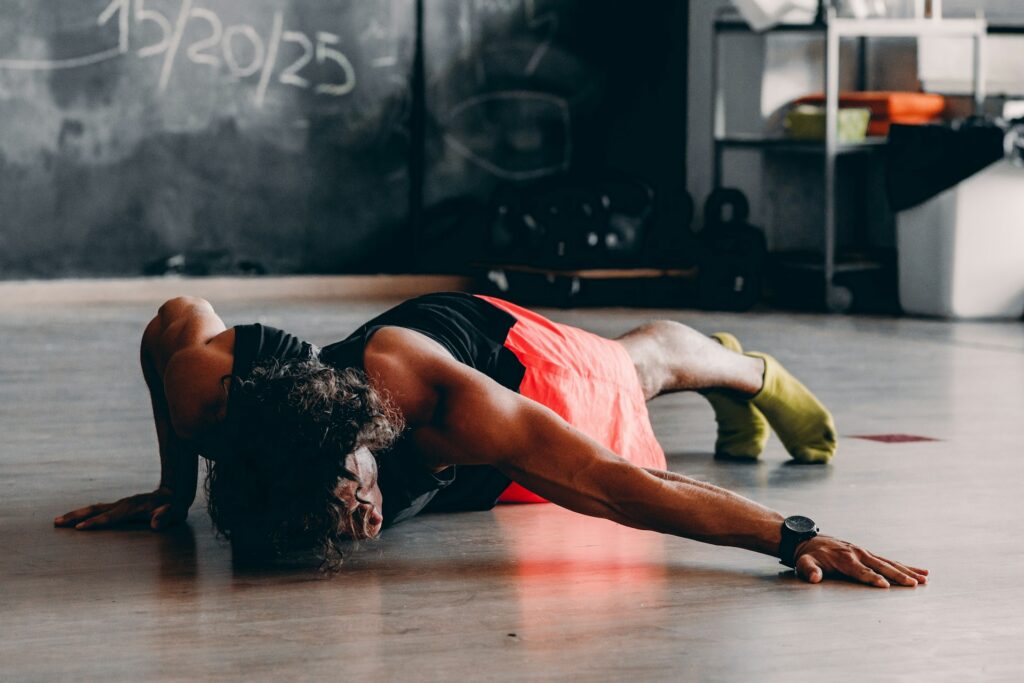
What Is Military Calisthenics?
Military calisthenics refers to the bodyweight exercise system used by armed forces to develop combat-ready physical fitness. Unlike gym-based programmes built around machines and isolated muscle groups, military calisthenics focuses on functional movements that transfer directly to carrying heavy loads, climbing, crawling, sprinting, and sustained physical effort under stress.
Every major military organisation uses calisthenics as the foundation of its physical training. The US Army Fitness Test (ACFT) is built around bodyweight and functional movements. The Royal Marines include daily calisthenics throughout their gruelling 32-week training. Navy SEALs use bodyweight circuits for conditioning no gym environment can replicate.
💡 Did You Know? Research on military trainees confirms progressive bodyweight circuits build the strength endurance, core stability, and power needed for physically demanding tasks. According to WHO physical activity guidelines, adults need both aerobic activity and muscle-strengthening exercises — military calisthenics satisfies both simultaneously in every session, making it one of the most time-efficient training approaches available.
Why Military Calisthenics Works: The Science
Functional, multi-joint movement patterns. Every core military calisthenics exercise trains multiple joints and muscle groups simultaneously, building real-world strength that transfers directly to demanding physical tasks.
High metabolic demand. Circuit-style military calisthenics burns 400–600 calories per hour and dramatically improves VO₂max over 6–12 weeks of consistent training.
Progressive overload without equipment. Bodyweight progression is extensive — from standard push-ups to archer push-ups to one-arm push-ups. From assisted pull-ups to weighted pull-ups. Military calisthenics offers a progression continuum rivalling any barbell programme.
Injury resilience through proprioception. Training with bodyweight develops the body awareness that machine-based training does not — producing better body control, balance, and coordination that reduces injury risk during complex physical tasks.
10 Core Military Calisthenics Exercises
1. Push-Ups
Muscles targeted: Chest, shoulders, triceps, core. The defining exercise of military calisthenics — the backbone of every armed forces PT session worldwide. Correct form: high plank, hands slightly wider than shoulder-width, body straight from head to heels. Lower until chest nearly touches the floor, push explosively to full arm extension. Progression: knee → standard → diamond → decline → archer → one-arm push-ups.
2. Pull-Ups and Chin-Ups
Muscles targeted: Lats, rhomboids, traps, rear delts, biceps. The defining test of upper body pulling strength in military calisthenics — required by the US Marine Corps PFT and the Royal Marines Commando Test. Dead hang start, pull until chin clears the bar, lower with full control. No kipping or momentum — military standards demand strict form.
3. Squats
Muscles targeted: Quadriceps, glutes, hamstrings, core. Performed at high volume in military settings — sets of 50–100 reps — to build the muscular endurance needed for sustained marching and load carrying. Progression: standard → jump squat → Bulgarian split squat → pistol squat.
4. Burpees
Muscles targeted: Full body + cardiovascular system. The most complete conditioning exercise in military calisthenics — combining push-up, jump, and squat in one movement. Military-standard burpees add a strict push-up at the bottom and a full jump with clap overhead at the top. A set of 50 burpees challenges any fitness level.
5. Plank
Muscles targeted: Deep core, obliques, erector spinae, shoulders. The plank replaced the sit-up in the US Army ACFT in 2020 due to sit-up injury risk. It develops deep core stability through isometric contraction — the type of core strength that protects the spine during load carrying. Standard: 60-second hold with a perfectly straight body.
6. Lunges
Muscles targeted: Quadriceps, glutes, hamstrings, single-leg balance. Walking lunges performed for distance (20–40 metres) directly mimic the unilateral loading demands of marching with a heavy pack. Progress to reverse lunges, lateral lunges, and jumping lunges as fitness increases.
7. Dips
Muscles targeted: Triceps, chest, anterior deltoids. Dips develop pushing strength through a greater range of motion than push-ups. Military calisthenics turns any environment into a gym — improvised bars, benches, and parallel structures all serve. Progression: bench dips → parallel bar dips → weighted dips.
8. Mountain Climbers
Muscles targeted: Core, shoulders, hip flexors, cardiovascular system. From a high plank, alternate driving each knee toward the chest in a running motion for 30–60 seconds continuously. A key military calisthenics transition exercise that elevates heart rate rapidly without requiring any equipment.
9. Jumping Jacks
Muscles targeted: Full body, cardiovascular system, hip abductors. One of the oldest military calisthenics exercises — used since World War II as a cardiovascular warm-up and active recovery movement. Sets of 100 jumping jacks maintain cardiovascular demand between strength exercises without fatiguing primary muscle groups.
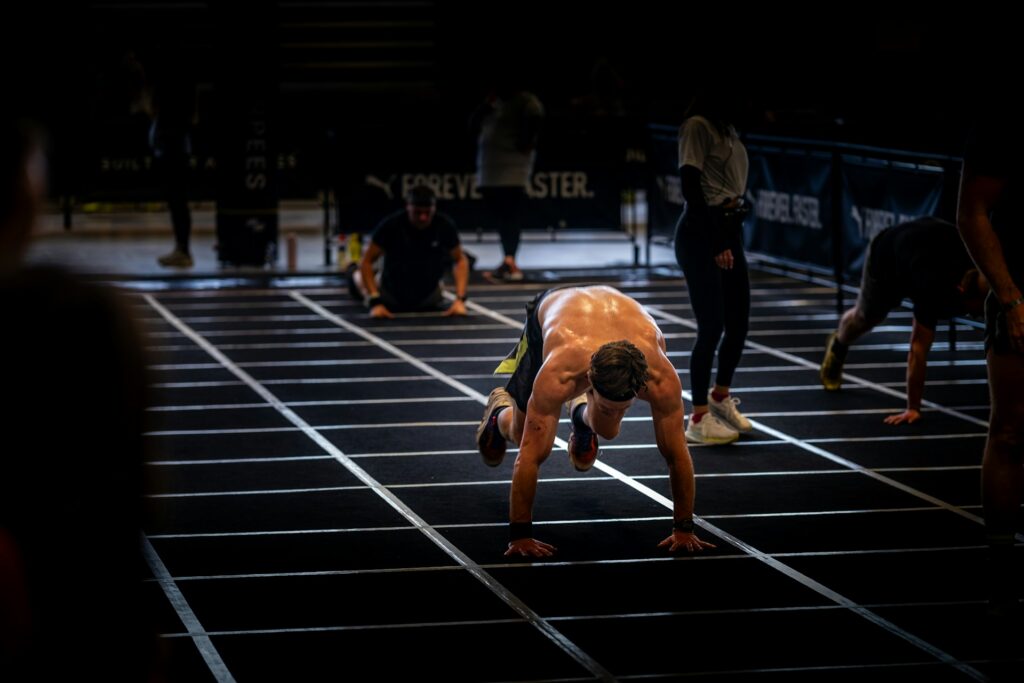
10. Bear Crawls
Muscles targeted: Shoulders, core, quads, coordination, cardiovascular system. Moving on all fours with knees hovering just above the ground develops shoulder stability, core anti-rotation strength, and coordination. Performed for 20–40 metres, they are one of the most challenging and functional military calisthenics exercises. Our full body workout guide covers how to integrate these functional movements into a complete weekly training plan.
Complete Military Calisthenics Workout
Perform this military calisthenics circuit 3–4 times per week with at least one rest day between sessions.
Warm-Up (5 min): Jumping jacks (1 min) | Arm circles (30 sec) | Leg swings (30 sec each) | Hip circles (30 sec) | Jogging in place (2 min)
Circuit A — Strength (3 rounds, 60 sec rest): Push-ups × 20 | Pull-ups × 10 | Squats × 30 | Dips × 15 | Plank × 60 sec
Circuit B — Conditioning (3 rounds, 45 sec rest): Burpees × 15 | Mountain climbers × 30 sec | Jump squats × 20 | Walking lunges × 20 | Jumping jacks × 50
Finisher: Bear crawl 20m forward and back × 3 | Plank 60 sec | 100 jumping jacks. This military calisthenics finisher replicates the end-of-session demand when soldiers must continue performing despite significant accumulated fatigue.
4-Week Military Calisthenics Training Plan
Week 1 — Foundation: 3 sessions/week. Circuit A only, 2 rounds. Focus entirely on form. Reduce reps if form breaks. This is the week to learn how military calisthenics movements feel when done correctly.
Week 2 — Build: 3–4 sessions/week. Add Circuit B. 2 rounds each. Add 1km run per session. Track push-up and pull-up numbers — progressive overload in military calisthenics starts with adding 1–2 reps per session.
Week 3 — Intensify: 4 sessions/week. 3 rounds both circuits. Add 2km run. Finisher every session. Reduce rest by 15 seconds. Replace standard push-ups with diamond push-ups in one circuit.
Week 4 — Peak: 4–5 sessions/week. Maximum effort throughout. 3km run. Target: complete full workout under 45 minutes. Test max push-ups and pull-ups — compare to Week 1. Most beginners improve 30–50% over 28 days of consistent military calisthenics.
Military Calisthenics Progressions
Volume: Add 2–3 reps per exercise each week. When 20 strict pull-ups are achievable, add weight. When 50 push-ups are easy, move to archer or one-arm progressions.
Density: Reduce rest intervals progressively until circuits flow continuously with minimal planned rest.
Complexity: Introduce plyometric variations — clap push-ups, jump squats, explosive burpees — that develop power alongside endurance. According to NHS strength exercise guidelines, exercises should be progressive and varied to continue producing adaptation. For complementary lower body work, our guide on glute exercises covers hip-hinge and single-leg movements that pair naturally with military calisthenics programming.
Frequently Asked Questions
What is military calisthenics?
Military calisthenics is the bodyweight exercise system used by armed forces worldwide to develop functional strength, cardiovascular endurance, core stability, and mental resilience. It uses push-ups, pull-ups, squats, burpees, planks, and lunges — movements requiring no equipment that transfer directly to the physical demands of military service.
Can military calisthenics build muscle?
Yes — military calisthenics builds significant muscle when progressive overload is consistently applied. Progressing from standard push-ups to archer push-ups to one-arm push-ups, or from bodyweight squats to pistol squats, provides sufficient challenge for meaningful muscle hypertrophy. Research on military trainees confirms bodyweight programmes build functional muscle mass alongside the strength endurance that characterises military fitness.
How many days a week should I do military calisthenics?
Most military calisthenics programmes recommend 3–5 sessions per week with at least one rest day between sessions. Beginners should start at 3 weekly sessions. Consistency matters more than frequency — 3 sessions per week maintained for 6 months produces far greater results than 5 sessions per week for 3 weeks then stopping.
Is military calisthenics good for weight loss?
Yes — military calisthenics is excellent for weight loss because it combines resistance training and cardiovascular conditioning simultaneously. Circuit-style military calisthenics burns 400–600 calories per session while building muscle, increasing basal metabolic rate and accelerating fat loss even during rest.
🪖 Train Like a Warrior
Military calisthenics is the most battle-tested training system in human history. It requires nothing but your body, a small space, and the willingness to push through discomfort. Start where you are. The training makes you fit. 💚
✍️ About the Author
This article was written by the editorial team at Blooming Vitality, a health and wellness platform dedicated to evidence-based fitness guidance.