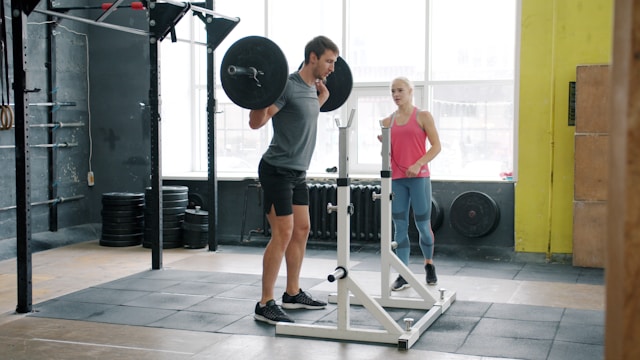
⚡ TL;DR — Full Body Workout
- A full body workout trains all major muscle groups in a single session, making it the most time-efficient training approach for most people.
- 3x per week is the optimal frequency — giving each muscle group enough stimulus while allowing adequate recovery.
- Compound movements (squat, deadlift, push, pull) deliver the best results per minute of training time.
- No gym required — a well-designed full body workout with bodyweight only produces measurable strength and fitness gains.
A full body workout is the training approach that gets results without requiring hours at the gym — and for most people, it’s objectively the smartest way to train. Whether you’re new to exercise or an experienced lifter, training your entire body in each session builds strength, burns fat, and improves fitness more efficiently than split routines, especially when time is limited. This guide gives you everything you need: the science behind why full body training works, a complete workout you can do anywhere, and the principles that will make your training sustainable for years.
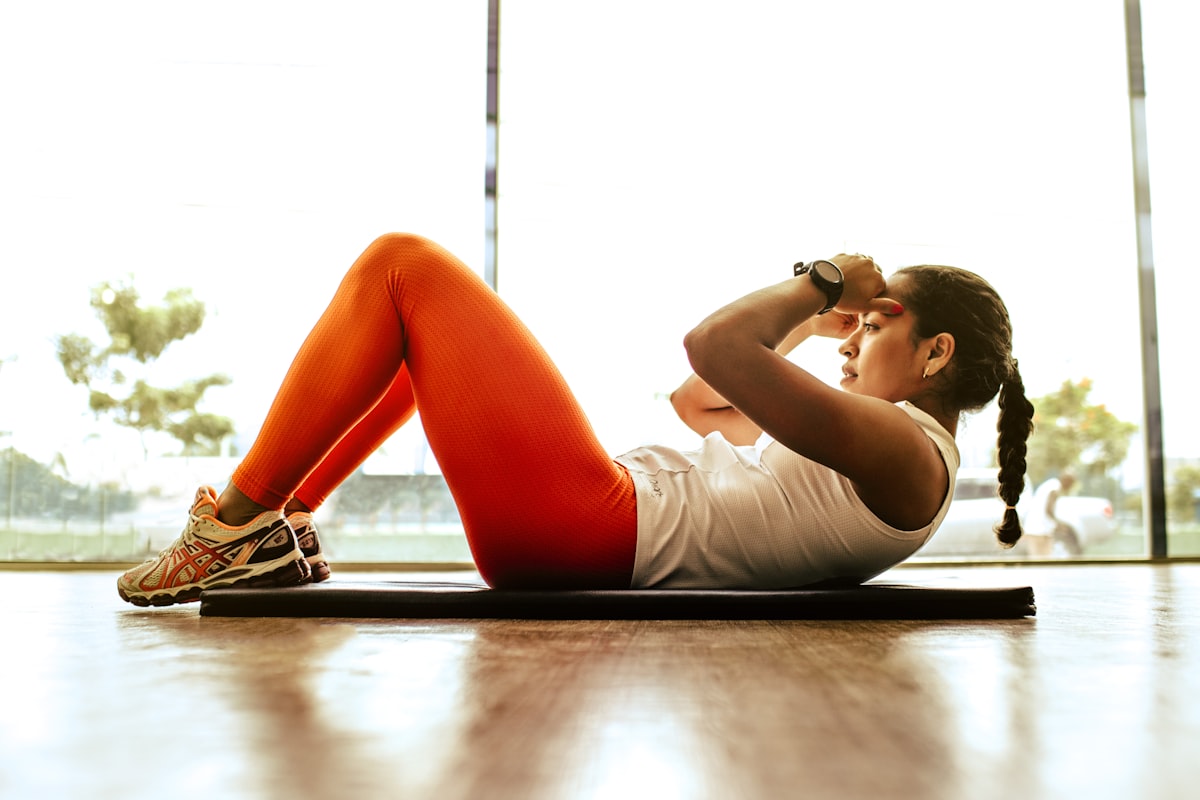
What Is a Full Body Workout?
A full body workout is any exercise session designed to train all major muscle groups — chest, back, shoulders, arms, core, glutes, quadriceps, hamstrings, and calves — within the same workout. Unlike split routines (where you dedicate different days to different muscle groups), full body training distributes the training stimulus evenly across the body in each session. This makes it particularly effective for beginners building their initial fitness base, intermediates looking to maximise results with limited gym time, and anyone training 2–4 days per week.
The Science: Why Full Body Workouts Work So Well
Research consistently shows that full body workout approaches produce equivalent or superior hypertrophy (muscle growth) and strength gains compared to split routines when total weekly volume is matched. The key advantage is frequency: each muscle group is trained 3 times per week rather than once, which triggers the muscle protein synthesis response (the growth signal) more often. A landmark 2016 meta-analysis in the Journal of Strength and Conditioning Research found that training a muscle group twice per week produced significantly greater hypertrophy than once per week — full body training naturally achieves this 3x frequency. WHO guidelines recommend adults do muscle-strengthening activities involving all major muscle groups at least 2 days per week — a full body workout format satisfies this requirement in the most efficient way possible.
💡 Did You Know? After a strength training session, muscle protein synthesis (the process that builds and repairs muscle) remains elevated for 24–48 hours. Full body training — by hitting each muscle 3 times per week — keeps this growth signal active almost continuously, which is why it’s so effective for both beginners and experienced lifters.
7 Best Full Body Workout Exercises
1. Squat (or Goblet Squat)
The king of lower body exercises — the squat trains the quadriceps, hamstrings, glutes, and core simultaneously. For a full body workout, start with a bodyweight squat or goblet squat (holding a dumbbell or kettlebell at chest height) to develop the movement pattern safely. Keep your chest up, weight in your heels, and knees tracking over your toes throughout the movement. 3–4 sets of 8–15 reps.
2. Deadlift (or Romanian Deadlift)
The deadlift trains the entire posterior chain — glutes, hamstrings, lower back, and traps. The Romanian Deadlift (RDL) is the most accessible and safest variation for beginners: holding dumbbells, hinge at the hip with soft knees, lowering weights along your legs until you feel a strong hamstring stretch, then drive through the hips to stand. 3 sets of 8–12 reps.
3. Push-Up (or Dumbbell Press)
The push-up trains chest, shoulders, and triceps while also requiring core stability. It’s one of the best upper body exercises for a full body workout precisely because it requires no equipment and can be scaled easily — from incline push-ups for beginners to weighted or decline push-ups for advanced trainees. 3–4 sets to within 2–3 reps of failure.
4. Row (Dumbbell or Resistance Band)
Rows train the back (latissimus dorsi, rhomboids, rear deltoids) and biceps — the pulling muscles that balance out all the pressing. Dumbbell rows, resistance band rows, or even a TRX row if you have access to one are all excellent options. Aim for at least as many pulling reps as pushing reps in each session for shoulder health. 3–4 sets of 10–15 reps.
5. Overhead Press
The overhead press develops shoulder strength, upper back stability, and tricep power. It’s a functional movement that mirrors real-life pushing actions above head height. Start light to develop the technique — brace your core tightly and avoid arching the lower back excessively. 3 sets of 8–12 reps.
6. Plank (or Hollow Hold)
Core stability is the foundation of every other exercise in a full body workout — and the plank is its most accessible trainer. A proper plank engages the entire anterior core: rectus abdominis, transverse abdominis, and obliques. Progress to longer holds (up to 60 seconds) and more challenging variations as you get stronger.
7. Lunge or Split Squat
Lunges and split squats train each leg individually — addressing strength imbalances that bilateral squats can mask. They also require greater hip mobility and single-leg stability, making them excellent for athletic performance and injury prevention. 3 sets of 8–12 reps per leg.
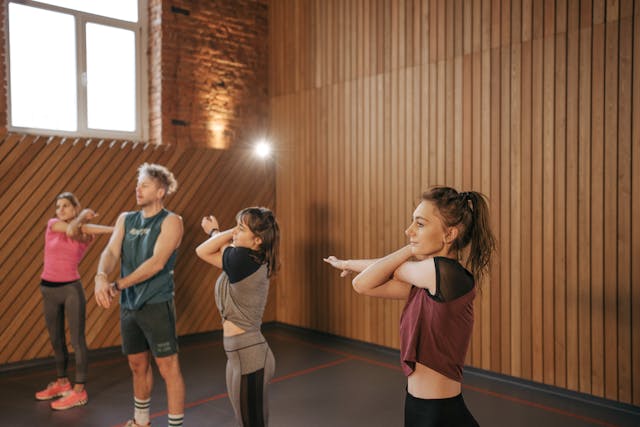
A Complete Full Body Workout Routine
Here’s a practical, equipment-minimal full body workout that can be done at home or in the gym. Perform this 3x per week with at least one rest day between sessions.
| Exercise | Sets | Reps | Rest |
|---|---|---|---|
| Goblet Squat | 3 | 10–12 | 90 sec |
| Romanian Deadlift | 3 | 10–12 | 90 sec |
| Push-Up | 3 | To near failure | 60 sec |
| Dumbbell Row | 3 | 12 per arm | 60 sec |
| Overhead Press | 3 | 10–12 | 90 sec |
| Walking Lunges | 3 | 10 per leg | 60 sec |
| Plank | 3 | 30–60 sec | 45 sec |
Common Full Body Workout Misconceptions
“You’ll be too sore to train again in 48 hours.” Initial muscle soreness (DOMS) is most severe when starting a new program. After 2–3 weeks of consistent training, soreness reduces significantly while strength continues to improve. Training through mild soreness is generally fine — it’s severe pain that warrants a rest day.
“Full body workouts are only for beginners.” Elite powerlifters and Olympic weightlifters train their entire body in each session. Full body training is effective at every experience level — the difference lies in the volume, intensity, and exercise selection, not the concept.
How to Build a Weekly Full Body Workout Plan
The most effective structure for a full body workout plan is 3 non-consecutive days per week — Monday/Wednesday/Friday is classic. Vary the exercises slightly between sessions (e.g. front squat on Monday, split squat on Wednesday, back squat on Friday) to prevent adaptation and keep training engaging. Progressively add weight or reps week by week — this progressive overload principle is the single most important driver of long-term fitness gains. Pair your training with adequate protein intake (1.6–2.2g per kg of bodyweight daily) and quality sleep for optimal recovery. For more fitness guidance and wellness support, visit our Fitness category at Blooming Vitality. The American College of Sports Medicine and National Strength and Conditioning Association provide excellent evidence-based exercise guidelines.
When to Seek Professional Guidance for Your Full Body Workout
A well-designed full body workout is safe for most healthy adults to begin without professional guidance. However, consult a doctor before starting if you have cardiovascular disease, osteoporosis, recent injury, or any condition that affects exercise tolerance. A certified personal trainer is worth the investment if you’re new to resistance training and want to learn technique correctly from the start — good movement patterns established early prevent years of compensatory injuries.
💪 Ready to start your full body workout journey?
Pick 3 days this week, do the routine above, and commit to 4 weeks. That’s enough time to feel dramatically stronger, more energetic, and to build the habit that changes everything. The best workout is the one you actually do consistently.
Disclaimer: Consult a qualified healthcare professional before starting a new exercise program, especially if you have existing medical conditions or injuries.