⚡ TL;DR
- Seed cycling involves eating specific seeds during each phase of your menstrual cycle to support oestrogen and progesterone production.
- Phase 1 (days 1–14): flaxseeds and pumpkin seeds to support oestrogen.
- Phase 2 (days 15–28): sesame seeds and sunflower seeds to support progesterone.
- While clinical evidence is limited, the nutritional profiles of these seeds genuinely support hormone health — and many women report meaningful benefits.
Seed cycling has become one of the most discussed natural approaches to hormone balance in women — and for good reason, even if the science is still catching up with the anecdotal enthusiasm. The practice is simple: eat specific seeds during each phase of your menstrual cycle to provide the nutrients your body needs to produce and metabolise oestrogen and progesterone appropriately. Whether you’re dealing with PMS, irregular cycles, PCOS, or perimenopause, seed cycling is a gentle, food-first tool worth understanding.
What Is Seed Cycling?
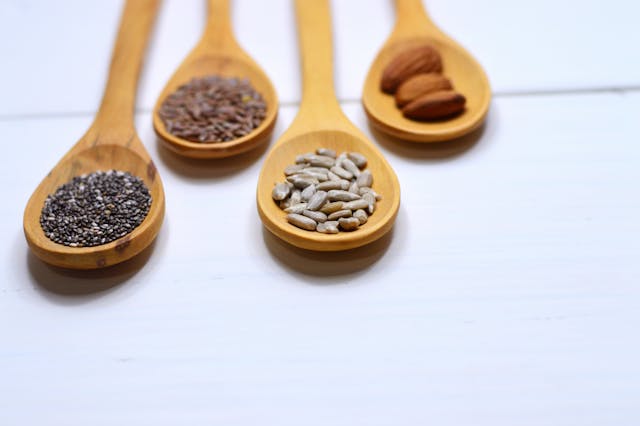
Seed cycling is a nutritional practice that rotates four types of seeds — flaxseeds, pumpkin seeds, sesame seeds, and sunflower seeds — across the two main phases of the menstrual cycle. The theory is that the specific nutrients in each seed pair (lignans, zinc, selenium, vitamin E, and phytoestrogens) support the body’s natural hormonal shifts during the follicular phase (days 1–14) and the luteal phase (days 15–28).
For women who no longer have a regular cycle (due to perimenopause, PCOS, or other reasons), seed cycling can be timed to the moon cycle or started at any consistent 28-day rhythm.
The Science Behind Seed Cycling
It’s important to be honest: there are no large clinical trials specifically on seed cycling as a protocol. However, the nutritional science behind why the individual seeds were chosen is solid.
Flaxseeds contain lignans — plant compounds that bind to oestrogen receptors and help modulate oestrogen activity, reducing excess oestrogen while supporting healthy levels. Research from the Journal of Clinical Endocrinology found that flaxseed supplementation significantly improved menstrual cycle length and luteal phase progesterone-to-oestrogen ratios in women with irregular cycles. Pumpkin seeds are rich in zinc, which is required for progesterone production and healthy ovulation. Sesame seeds contain sesamin (another lignan) that helps clear excess oestrogen via liver pathways. Sunflower seeds provide selenium and vitamin E — antioxidants that support corpus luteum function (the structure responsible for progesterone secretion after ovulation).
💡 Did You Know? Ground flaxseeds are up to 800 times richer in lignans than any other plant food. Their phytoestrogenic activity makes them uniquely suited to the first half of the cycle, when oestrogen naturally needs to rise to support follicle development.
How to Do Seed Cycling: Step by Step
Phase 1: Follicular Phase (Days 1–14, beginning of period)
Eat 1–2 tablespoons each of ground flaxseeds and raw pumpkin seeds daily. These support oestrogen production and metabolism. Add them to smoothies, porridge, yogurt, salads, or bake them into energy balls. Flaxseeds must be ground (not whole) for their lignans to be bioavailable.
Phase 2: Luteal Phase (Days 15–28, post-ovulation)
Switch to 1–2 tablespoons each of raw sesame seeds (or tahini) and raw sunflower seeds daily. These support progesterone production and clearance of excess oestrogen. They can be added to the same foods, or used as tahini in dressings, hummus, and stir-fry sauces.
Practical Tips for Seed Cycling
- Always use raw, unroasted seeds — heat destroys the delicate omega-3 fatty acids and alters the compounds that make these seeds hormonally active.
- Grind flaxseeds fresh or buy pre-ground and store in the freezer to prevent oxidation.
- Give seed cycling at least 3 full cycles (3 months) before assessing results — hormonal shifts take time to manifest.
- Track your cycle, symptoms, mood, and energy to notice changes objectively.
Potential Benefits of Seed Cycling
Women who practice seed cycling consistently report improvements in PMS symptoms (bloating, breast tenderness, irritability), more regular cycle length, reduced period pain, better mood stability across the cycle, improved skin (particularly hormonal acne), and more energy in the first half of their cycle. For perimenopausal women, seed cycling may help smooth the erratic hormone fluctuations of this transition. For women with PCOS, the lignan and zinc content addresses two key drivers: oestrogen dominance and zinc deficiency.
A Real-Life Example
Priya, 38, had suffered from severe PMS — including 10 days of bloating, rage, and breast pain — for years. After 3 months of consistent seed cycling, she reported her PMS had reduced to 3–4 manageable days. She combined seed cycling with magnesium supplementation and reduced her caffeine intake. “It felt like a completely different cycle,” she said. “I was sceptical but the results were hard to argue with.”
Common Seed Cycling Misconceptions
“Seed cycling will fix my hormones overnight”
Seed cycling is a gentle, food-based support — not a pharmaceutical intervention. Results build gradually over months, not weeks. Expect meaningful changes after 3 complete cycles of consistent practice.
“The seeds need to be expensive or special”
Basic, raw flaxseeds, pumpkin seeds, sesame seeds, and sunflower seeds from any health food shop or supermarket are perfectly effective. You don’t need branded seed cycling blends — which are often overpriced for what they contain.
“Seed cycling is only for women with hormonal problems”
Seed cycling is a beneficial nutritional practice for any woman, regardless of whether she has diagnosed hormonal issues. The omega-3s, zinc, selenium, and lignans support overall health, gut function, and skin — not just hormone balance.
When to Seek Professional Help
Seed cycling is an excellent addition to a holistic hormone-support approach but should not replace medical evaluation for significant hormonal issues like PCOS, endometriosis, or thyroid dysfunction. If your symptoms are severe or worsening, seek evaluation from a GP or endocrinologist. For more natural hormone support strategies, explore our nutrition guides on Blooming Vitality.
🌿 Small Seeds, Big Impact
Seed cycling is one of the simplest, most affordable, and most sustainable tools in the hormonal health toolkit. Two tablespoons of seeds a day, timed to your cycle — that’s it. Give it three months and let your body show you what targeted nutrition can do.