⚡ TL;DR — How Much CBD Oil Should I Take?
- How much CBD oil should I take depends on your body weight, health goal, and the product’s concentration — there is no universal dose.
- A safe starting point for most beginners is 5–15 mg per day, increasing gradually every 5–7 days until you find your effective dose.
- For anxiety or sleep, most people find relief between 25–75 mg; for chronic pain, doses up to 150 mg are common.
- Always choose third-party tested CBD oil and consult a doctor if you take prescription medications.
If you’ve ever Googled “how much CBD oil should I take,” you already know the frustration — the answers are all over the place. One article says 10 mg. Another says 50 mg. A product label gives a range so broad it’s practically useless. The truth is that how much CBD oil you should take is highly individual, and there’s no single number that works for everyone. But there is a clear, science-backed framework that makes it easy to find your personal dose — and that’s exactly what this guide delivers.
📋 Table of Contents
Why There’s No Standard CBD Dose

When people ask how much CBD oil should I take, they often expect a simple answer. But CBD doesn’t work like ibuprofen, where 400 mg is the standard dose for most adults. CBD interacts with your endocannabinoid system (ECS) — a network of receptors that varies significantly between people. Your body weight, metabolism, the condition you’re addressing, your tolerance, and the quality and concentration of the product you’re using all influence how much CBD you actually need.
According to research published in the journal Cannabis and Cannabinoid Research, effective CBD doses in clinical studies have ranged from as low as 5 mg to as high as 1,500 mg per day — a range so wide it reflects just how individual the response truly is. The good news: starting low and increasing gradually is both safe and effective for the vast majority of people.
CBD Dosage by Body Weight
Body weight is one of the most reliable starting points when answering the question of how much CBD oil should I take. A widely used general guideline suggests 1–6 mg of CBD for every 10 pounds (4.5 kg) of body weight, with the lower end for mild conditions and the higher end for more significant symptoms.

Here’s a simple weight-based reference table to guide your starting dose:
| Body Weight | Low Dose (mild) | Medium Dose (moderate) | High Dose (severe) |
|---|---|---|---|
| 100–130 lbs (45–59 kg) | 10–15 mg | 20–30 mg | 35–45 mg |
| 130–170 lbs (59–77 kg) | 15–20 mg | 25–40 mg | 45–65 mg |
| 170–210 lbs (77–95 kg) | 20–25 mg | 35–50 mg | 55–80 mg |
| 210+ lbs (95+ kg) | 25–30 mg | 45–60 mg | 70–100+ mg |
These are starting points, not fixed prescriptions. Use the lower end if you’re brand new to CBD, and adjust gradually based on your response after at least 5–7 days at each dose.
💡 Did You Know? A 2019 review in Frontiers in Pharmacology found that CBD displays a U-shaped dose-response curve for anxiety — meaning very high doses can actually become less effective than moderate doses. This is another reason to find your personal minimum effective dose rather than assuming more is better.
How Much CBD Oil Should I Take for Different Conditions
One of the most important variables in determining how much CBD oil to take is what you’re using it for. Different conditions call for meaningfully different doses — here’s what the current research suggests for each major use case.
CBD Oil for Anxiety
Anxiety is the most common reason people start using CBD oil. Research indicates a typical effective dose for anxiety falls between 25–75 mg per day, with many people finding that 25–50 mg taken 30–60 minutes before a stressful event (such as public speaking or a difficult conversation) works particularly well. A landmark 2019 study in The Permanente Journal found that 79% of patients reported lower anxiety scores after one month of CBD use at doses of 25–75 mg daily.
CBD Oil for Sleep
For sleep support, slightly higher doses tend to work better. Most research points to 25–75 mg taken 30–60 minutes before bed as an effective range for improving sleep onset and quality. At doses above 150 mg, CBD appears to have mild direct sedative properties. If you’re primarily struggling with anxiety-driven insomnia, starting at 25 mg is sensible — if it’s pain-related sleep disruption, you may need a higher dose.
CBD Oil for Pain and Inflammation
For how much CBD oil should I take for pain, the evidence supports higher doses than for anxiety. Chronic pain users commonly report needing 50–150 mg per day, sometimes split into two or three doses. A 2018 review in the Journal of Pain Research noted that CBD’s pain-modulating effects are dose-dependent — meaning you may need to work up gradually to find the dose that adequately addresses your pain level.
CBD Oil for General Wellness
If you’re using CBD oil as part of a general daily wellness routine without a specific condition to address, a lower maintenance dose of 10–25 mg per day is typically sufficient. Many people use this as a baseline and increase only during periods of higher stress, disrupted sleep, or physical discomfort.
How Product Type Affects Your CBD Dose
When asking how much CBD oil should I take, it’s essential to understand that the format you choose significantly affects both onset time and how much of the CBD your body actually absorbs — a concept called bioavailability.
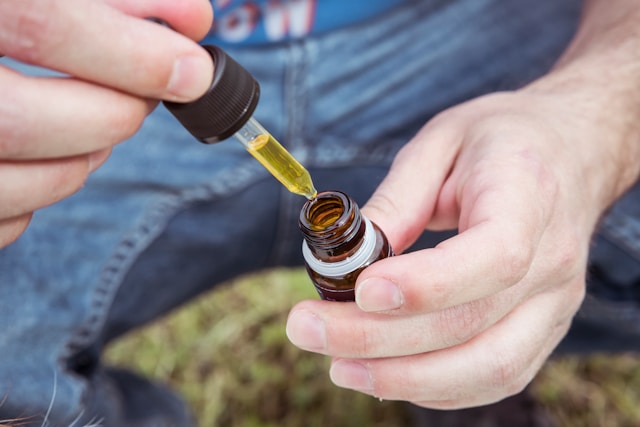
- Sublingual CBD oil (drops under the tongue): Highest bioavailability (~20–35%). Effects within 15–30 minutes. Hold the oil under your tongue for 60 seconds before swallowing for best absorption.
- CBD gummies and capsules: Lower bioavailability (~6–15%) due to first-pass liver metabolism. Takes 45–90 minutes to kick in but lasts longer. You may need a higher mg dose to achieve the same effect as sublingual oil.
- CBD vapes: Very high bioavailability (~35–56%) but effects last only 1–3 hours. Not recommended for people with respiratory concerns.
- Topical CBD (creams, balms): Works locally — doesn’t enter the bloodstream. Ideal for joint or muscle pain but won’t help with anxiety or sleep.
This means if you’ve been taking 25 mg CBD gummies without great results, switching to the same dose in sublingual oil form could produce a notably stronger effect — because more CBD is reaching your system.
How to Start: The Low-and-Slow Method for How Much CBD Oil to Take
The safest and most effective approach to figuring out how much CBD oil should I take is called low-and-slow titration. Here’s the method:
- Week 1: Start at 5–10 mg per day (or the low-end weight-based dose above). Take notes on sleep quality, mood, anxiety, and any physical discomfort.
- Week 2: If you notice no improvement and no side effects, increase by 5 mg.
- Week 3 onwards: Continue increasing in 5 mg increments every 5–7 days until you notice clear benefits.
- Maintenance: Once you find the dose that works, stay there. Don’t keep increasing just because you can.
Keep a simple daily log — dose, time taken, and a 1–10 rating of how you felt 1 hour and 4 hours later. This data makes it easy to identify your personal sweet spot within 3–4 weeks. For a related look at how CBD compares to other hemp supplements, see our guide on CBG vs CBD Oil: What’s the Difference?
A Real-World CBD Dosing Example
Meet Sarah, 34, a marketing manager who started using CBD oil for work-related anxiety and disrupted sleep. She weighs 145 lbs and was completely new to CBD. Following the low-and-slow approach to figuring out how much CBD oil to take, here’s how her first month looked:
- Week 1: 10 mg sublingual oil each evening. Noted slightly better sleep, no anxiety change.
- Week 2: Increased to 20 mg. Sleep improved noticeably, mild reduction in daytime anxiety.
- Week 3: Increased to 30 mg. Anxiety significantly reduced. Sleep consistently better.
- Week 4: Stayed at 30 mg. No need to increase — this became her daily maintenance dose.
Sarah’s experience reflects a typical beginner journey. The right dose for her body was 30 mg — not 10 mg, not 100 mg. Titrating slowly helped her find it without wasting product or experiencing unwanted effects.
Common CBD Dosage Misconceptions
“More CBD is always better.” This is false. CBD follows a bell-curve dose-response for some effects (especially anxiety), where there’s a clear sweet spot and going higher can be less effective or cause side effects like fatigue and digestive upset. The goal with how much CBD oil to take is always to find your minimum effective dose.
“The label’s serving suggestion is my dose.” Product label recommendations are highly conservative and often don’t reflect individual needs. A 25 mg serving suggestion is a legal and marketing standard — not a clinical dosing protocol. Use the weight-based and condition-based guidelines above as your actual starting point.
“CBD works immediately.” For some people and some conditions, it can take 2–4 weeks of consistent daily use to notice meaningful results — especially for anxiety and sleep. The endocannabinoid system responds to sustained supplementation, not just single doses. Be patient and stay consistent before concluding a dose isn’t working.
Building a Daily CBD Oil Routine Around How Much CBD Oil to Take
Once you’ve established how much CBD oil you should take, consistency is the key to getting the most from it. The endocannabinoid system responds better to daily maintenance supplementation than to irregular use. Here are three simple daily templates based on your primary goal:
- For anxiety: 25–50 mg in the morning with breakfast, and a second 25 mg dose if you face a high-stress situation during the day.
- For sleep: 25–75 mg taken 30–60 minutes before your target bedtime. Use sublingual oil for faster onset.
- For general wellness: 10–25 mg at any consistent time of day. Morning with coffee or evening before bed both work well.
Always choose CBD oil with a third-party Certificate of Analysis (COA) from an independent lab. This verifies actual cannabinoid content, confirms THC is below 0.3%, and checks for contaminants like pesticides and heavy metals. Without a COA, you simply don’t know what’s actually in the bottle. For more detail on how CBD compares to other hemp supplements in your routine, check out our full guide to CBG Oil Benefits vs CBD Oil Benefits.
When to Seek Professional Help
While CBD is widely considered safe and well-tolerated, there are situations where professional guidance is essential before determining how much CBD oil you should take. If you take prescription medications — particularly blood thinners (like warfarin), antidepressants, anti-epileptics, or immunosuppressants — speak with your doctor first. Both CBD and CBG interact with the liver’s CYP450 enzyme system, which means they can affect how your body metabolises certain drugs.
Pregnant and breastfeeding individuals should avoid CBD unless specifically advised by a healthcare provider. The FDA has noted that there is insufficient evidence to confirm CBD’s safety during pregnancy. If you experience persistent side effects such as significant fatigue, changes in appetite, or elevated liver enzymes, reduce your dose and consult a healthcare professional.
🌿 Ready to find your perfect CBD oil dose?
Start low, track your response, and increase gradually every week. Most people find their sweet spot within 3–4 weeks — and the difference it makes to anxiety, sleep, and daily wellness is well worth the patience. Always choose third-party tested products for the safest results.
Disclaimer: The information in this article is for educational purposes only and has not been evaluated by the FDA. CBD products are not intended to diagnose, treat, cure, or prevent any disease. Always consult a qualified healthcare professional before starting any new supplement regimen.