💚 TL;DR
- The best dumbbell back exercises target your lats, rhomboids, traps, and erector spinae — and research shows dumbbells activate 20–30% more stabiliser muscles than machines, producing better functional strength and muscle development.
- The bent-over dumbbell row is the cornerstone of any back workout — a compound movement targeting lats, rhomboids, and mid-traps simultaneously.
- Science supports mixing vertical pulls, horizontal pulls, and isolation moves to maximise back width and thickness — dumbbells alone can achieve this without a single machine.
- Train back 2–3 times per week with 48 hours rest between sessions, using 4 sets of 8–12 reps for compound movements and 3 sets of 12–15 for isolation exercises.
Dumbbell back exercises are among the most effective tools for building a strong, thick, and well-developed back — and unlike machines or barbells, they require no specialist equipment, correct muscle imbalances, and provide a greater range of motion per repetition.
The back is one of the largest and most complex muscle groups in the body, comprising the latissimus dorsi, rhomboids, trapezius, erector spinae, teres major, and rear deltoids. Training these muscles effectively transforms posture, reduces injury risk, improves athletic performance, and creates the V-taper physique that no amount of chest work alone can produce.
This guide covers the 10 best dumbbell back exercises with precise technique cues, the muscles each one targets, how to build a complete dumbbell back workout, and the key training principles that make the difference between looking busy and actually building a stronger back.
⚕️ Medical Disclaimer: This article is for informational purposes only. If you have a history of lower back injury, shoulder impingement, or disc problems, consult a physiotherapist before beginning a new back training programme.
Last updated: May 2026
Back Muscles Targeted by Dumbbell Back Exercises
Understanding which muscles your dumbbell back exercises are targeting ensures every session has a clear purpose. The back is not a single muscle — it is a layered system of muscles working together.
Latissimus dorsi (lats): The broad, wing-shaped muscles on the sides of your spine that give the back its width. The lats are responsible for shoulder adduction and extension — pulling the arm down and back. They are the primary target of rowing and pullover dumbbell back exercises.
Rhomboids: Located between the shoulder blades, rhomboids retract the scapulae. They are crucial for posture and are strongly activated during any rowing movement when you consciously squeeze the shoulder blades together at the top.
Trapezius (traps): The large diamond-shaped muscle running from the base of your skull down to the mid-spine and out to the shoulders. Upper traps shrug and elevate the shoulder blades; lower and middle traps depress and retract them. Different dumbbell back exercises target different regions of the trapezius.
Erector spinae: The long muscles running alongside the spine, responsible for spinal extension, posture, and stability. Essential for injury prevention and directly trained by deadlift and hyperextension-type dumbbell back exercises.
Rear deltoids and teres major: The rear portion of the shoulder and the small muscle beneath the lat. Both are involved in rowing movements and contribute to back thickness and shoulder health.
💡 Did You Know? Research shows that dumbbell back exercises activate 20–30% more stabiliser muscles than equivalent machine exercises. This is because dumbbells require the shoulder, core, and postural muscles to maintain position throughout each rep — producing better functional strength and more complete muscle development than fixed-axis machines. According to ACE Fitness exercise research, unilateral dumbbell rows are among the top-tier exercises for activating the mid and lower trapezius — muscles critical for shoulder health and injury prevention.
Why Dumbbells Are Superior for Back Training
Dumbbell back exercises offer several advantages over barbell and machine alternatives that are consistently supported by sports science research.
Greater range of motion: With a barbell row, the bar stops at your torso. With a dumbbell row, you can pull an extra inch or two beyond the barbell’s range, fully retracting the scapula and maximising the lat contraction. This extended range of motion directly increases muscle activation and growth stimulus.
Correction of muscle imbalances: Most people have a stronger dominant side. Bilateral barbell rowing allows the stronger side to compensate. Unilateral dumbbell back exercises — particularly single-arm rows — force each side to work independently, preventing the weaker side from falling further behind.
Joint-friendly mechanics: Dumbbells allow your wrists and elbows to rotate into the most comfortable position during the movement, reducing joint stress compared to fixed-grip barbell exercises. People with wrist, elbow, or shoulder discomfort often find dumbbell back exercises far more comfortable than their barbell equivalents.
10 Best Dumbbell Back Exercises
1. Bent-Over Dumbbell Row
Muscles targeted: Lats, rhomboids, middle traps, rear delts, erector spinae
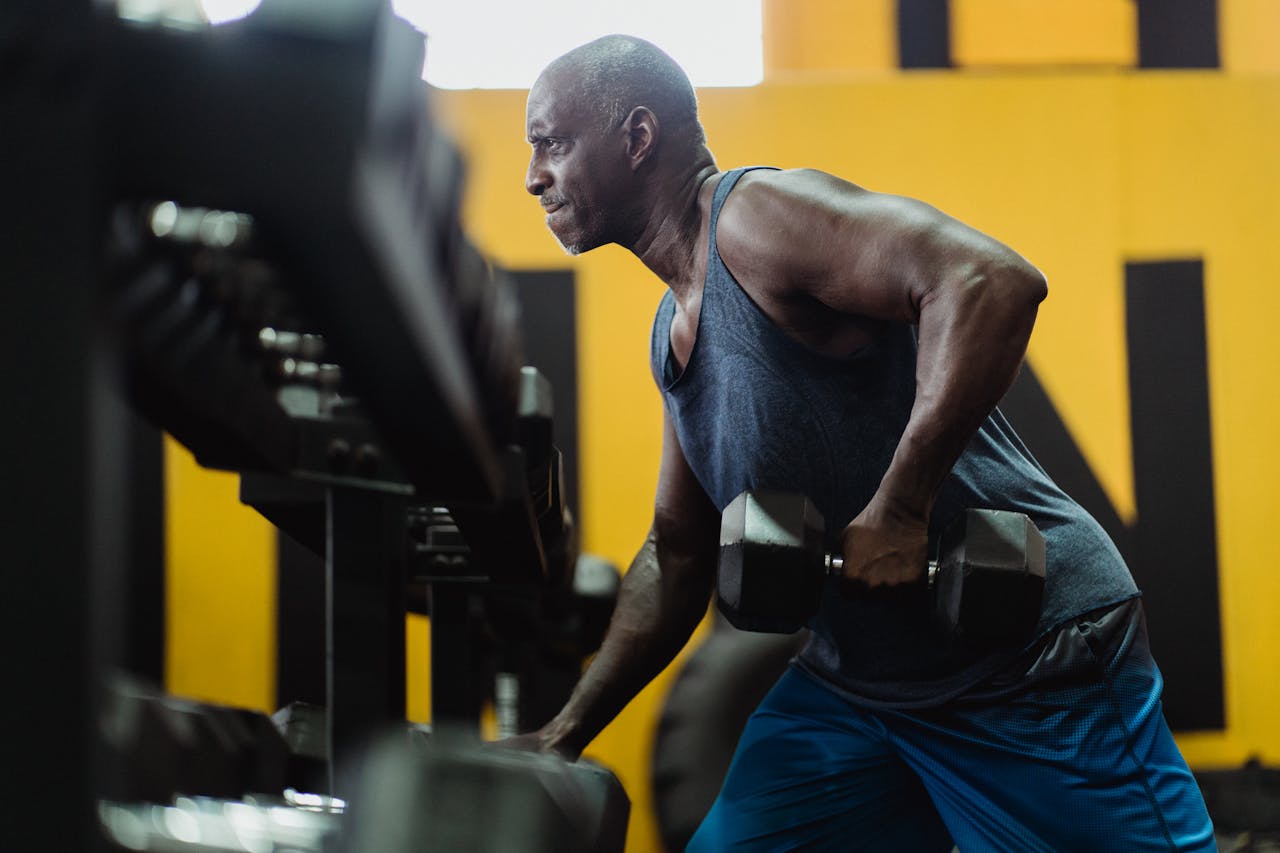
The bent-over dumbbell row is the cornerstone of all dumbbell back exercises — a compound movement that develops both back width and thickness simultaneously. Stand with feet hip-width apart, hinge at the hips until your torso is approximately 45° to the floor, and let the dumbbells hang directly below your chest. Pull both dumbbells toward your lower ribs, leading with the elbows and squeezing the shoulder blades together at the top. Lower with full control over 2–3 seconds.
The key technique cue: think of your hands as hooks and focus on driving your elbows back past your torso rather than curling with the biceps. This shift in mental focus dramatically increases back activation. Use 4 sets of 8–12 reps with a weight that makes the last 2 reps challenging.
2. Single-Arm Dumbbell Row
Muscles targeted: Lats, rhomboids, lower traps, rear delts — unilateral focus
The single-arm row is one of the most effective of all dumbbell back exercises for building unilateral lat thickness and correcting strength imbalances between sides. Place one knee and the same-side hand on a bench for support, keeping your back flat and parallel to the floor. Row the dumbbell toward your hip — not your shoulder — leading with the elbow and keeping it close to your body. Pause at the top for a full second, feeling the lat fully contracted before lowering.
A slight rotation at the top — rotating your torso fractionally toward the working side — maximises lat engagement at peak contraction. Avoid twisting excessively or using momentum. Use 3–4 sets of 10–12 reps per side.
3. Dumbbell Deadlift
Muscles targeted: Erector spinae, lats, traps, glutes, hamstrings — full posterior chain
The dumbbell deadlift is one of the most powerful dumbbell back exercises for the erector spinae and overall posterior chain development. Hold a dumbbell in each hand in front of your thighs, feet hip-width apart. Hinge at the hips with a slight knee bend, keeping your back straight and chest up. Lower the dumbbells along your legs until you feel a strong stretch in the hamstrings, then drive through the hips to return to standing, squeezing the glutes at the top.
The critical technique point is maintaining a neutral spine throughout — never round the lower back under load. Brace the core hard before initiating each rep. Use 3–4 sets of 8–10 reps with heavier weight than you’d use for rows.

4. Dumbbell Pullover
Muscles targeted: Lats, serratus anterior, chest (secondary), triceps (secondary)
The dumbbell pullover is unique among dumbbell back exercises — it targets the lats through a stretch-and-contraction arc that no rowing movement replicates. Lie perpendicular across a bench with only your upper back supported and feet flat on the floor. Hold a dumbbell with both hands above your chest, palms cupping one end. With a slight bend in the elbows, lower the dumbbell in an arc behind your head until you feel a deep stretch in the lats. Pull back to the starting position, focusing on squeezing the lats rather than the chest throughout.
The pullover is particularly effective for building lat width and rib cage expansion. Use a moderate weight that allows full range of motion — form and stretch are more important than load here. Aim for 3 sets of 12–15 reps.
5. Renegade Row
Muscles targeted: Lats, rhomboids, core, obliques, rear delts
The renegade row combines a plank with a single-arm row — making it one of the most demanding and functional dumbbell back exercises available. Start in a push-up position with hands gripping dumbbells placed shoulder-width apart on the floor. Keeping your hips square (not rotating), row one dumbbell toward your hip, then lower and repeat on the other side. Each rep requires the core and obliques to resist rotation, making this as much an anti-rotation core exercise as a back exercise.
Begin with lighter dumbbells than you’d use for regular rows — the stability demand is significantly higher. Use 3 sets of 8–10 reps per side. The renegade row is one of the best dumbbell back exercises for athletes who want back strength with full-body functional carryover.
6. Incline Bench Dumbbell Row
Muscles targeted: Mid-back, lats, traps, rear delts — with minimal lower back involvement
The incline bench row is one of the most overlooked dumbbell back exercises — and one of the best for people with lower back sensitivity. Set an adjustable bench to 30–45 degrees and lie chest-down on it. With a dumbbell in each hand, row them toward your sides with elbows at approximately 45 degrees to your torso. Because your chest is supported, all lower back strain is eliminated — making it ideal for people managing back discomfort who still want meaningful upper back training.
Keep your chest pressed firmly against the bench throughout and squeeze the shoulder blades together at the top of each rep. Use 3 sets of 12–15 reps at moderate weight, focusing on full muscle contraction rather than heavy load.
7. Dumbbell Shrug
Muscles targeted: Upper trapezius, levator scapulae
Dumbbell shrugs are the most direct of all dumbbell back exercises for the upper trapezius — the thick muscle that creates the sloping appearance from neck to shoulder. Stand upright holding a heavy dumbbell in each hand at your sides. Shrug both shoulders directly upward toward your ears in a straight vertical movement, hold for 1–2 seconds at the top, then lower with control. Crucially, do not roll the shoulders forward or backward — the movement is purely up and down.
Strong upper traps improve shoulder stability and neck health. Use relatively heavy weight for 3–4 sets of 12–15 reps, with a deliberate pause and contraction at the top of each rep.
8. Rear Delt Dumbbell Fly
Muscles targeted: Rear deltoids, rhomboids, middle trapezius
The rear delt fly addresses one of the most commonly underdeveloped areas in any back training programme — and is among the most important dumbbell back exercises for posture correction and shoulder health. Hinge forward at the hips to approximately 45° with a slight knee bend. Hold a light dumbbell in each hand with palms facing each other. With a slight bend in the elbows, raise both arms out to the sides in an arc until they are parallel with the floor, squeezing the rear delts and rhomboids at the top.
The rear delt fly requires light weight — heavier than you think leads to the traps and momentum taking over instead of the rear delts. ACE Fitness EMG research ranks this movement top-tier for activating the mid and lower traps. Use 3 sets of 15 reps with a strong focus on muscular contraction over load.
9. Dumbbell Y-Raise
Muscles targeted: Lower trapezius, rear delts — critical postural muscles
Y-raises are the most targeted of all dumbbell back exercises for the lower trapezius — a muscle that is almost universally weak in people who sit at desks for hours each day. Lie face-down on an incline bench set to 30–45 degrees. Hold very light dumbbells with palms facing down. Raise both arms overhead in a Y shape, thumbs pointing upward, squeezing the lower traps at the top. Hold for 1–2 seconds before lowering.
The lower trapezius depresses and upwardly rotates the shoulder blade — essential for healthy overhead movements and injury prevention. Use extremely light weight (2–5kg is appropriate even for advanced lifters) for 3 sets of 15 reps. The focus is entirely on feeling the lower back of the shoulder blade working, not moving significant load.
10. Dumbbell Superman
Muscles targeted: Erector spinae, glutes, posterior deltoids, rhomboids
The dumbbell superman is one of the best lower back-focused dumbbell back exercises for building spinal extension strength without any axial loading. Lie face-down with arms extended overhead, holding a very light dumbbell in each hand. Simultaneously lift your arms, chest, and legs off the floor by contracting the erector spinae and glutes. Hold the top position for 2–3 seconds before lowering. This mimics the position of a flying superhero — hence the name.
The dumbbell adds a small resistance to the arm raise component. Use 3 sets of 12–15 reps as an accessory movement or as part of a warm-up sequence. According to the NHS strength exercise guidelines, exercises targeting the lower back and posterior chain are essential for reducing the risk of back pain — one of the most common reasons people seek medical care globally.
Complete Dumbbell Back Workout
Here is a complete, evidence-based dumbbell back exercises workout organised by movement category. Perform this 2–3 times per week with at least 48 hours between sessions.
Warm-Up (5–8 minutes): Resistance band pull-aparts (2 × 20), scapular wall slides (2 × 10), light dumbbell rows (2 × 15 at 30% working weight). Never skip the warm-up for back training — the joints, tendons, and stabiliser muscles need preparation before heavy load.
Compound Movements (perform in order):
Bent-Over Dumbbell Row — 4 sets × 8–12 reps | Rest: 90 seconds
Single-Arm Dumbbell Row — 3 sets × 10–12 reps per side | Rest: 75 seconds
Dumbbell Deadlift — 3 sets × 8–10 reps | Rest: 2 minutes
Accessory Movements (perform in order):
Dumbbell Pullover — 3 sets × 12–15 reps | Rest: 60 seconds
Incline Bench Dumbbell Row — 3 sets × 12–15 reps | Rest: 60 seconds
Rear Delt Dumbbell Fly — 3 sets × 15 reps | Rest: 60 seconds
Corrective and Postural Finisher:
Dumbbell Y-Raise — 3 sets × 15 reps | Rest: 45 seconds
Dumbbell Shrug — 3 sets × 12–15 reps | Rest: 60 seconds
Total session time: 45–60 minutes. This complete dumbbell back exercises session addresses every major back muscle group through compound, accessory, and corrective movements — the three-layer approach sports scientists consistently recommend for maximising back development.
Key Training Principles for Dumbbell Back Exercises
Progressive overload is non-negotiable. For dumbbell back exercises to produce ongoing results, you must consistently challenge the muscles with more than they have previously handled. Track your weights and reps each session and aim to add either one rep or a small weight increment every 1–2 weeks. Without progressive overload, the muscles adapt to the existing stimulus and stop growing.
Lead with the elbow, not the hand. The most common technical error in all rowing dumbbell back exercises is pulling with the biceps rather than the back. Before each rep, consciously think “drive my elbow back.” This mental cue shifts the load from the arm to the back muscles where it belongs, and can increase back activation by up to 25% according to motor learning research on attentional focus.
Balance pulling and pushing volume. A healthy shoulder requires roughly equal pulling and pushing volume. Many people bench press twice a week but only row once — creating an anterior-dominant imbalance that leads to rounded shoulders and impingement risk. Aim for at least as many sets of dumbbell back exercises as you perform of chest and shoulder pressing across the week. Our full body workout guide covers how to balance pushing and pulling within a complete weekly training plan.
Mix vertical and horizontal pulling. Sports science from PubMed (2023) confirms that maximising back muscle size requires a combination of vertical pulling movements (targeting lats for width) and horizontal pulling movements (targeting rhomboids and mid-traps for thickness). This dumbbell back workout incorporates both — the pullover provides a vertical pull pattern while all rows provide horizontal pulling. For glute-focused training that complements a back development programme, our guide on glute exercises covers the posterior chain movements that pair naturally with back training.
Frequently Asked Questions
Can you build a big back with only dumbbell back exercises?
Yes — science shows that with progressive overload, dumbbell back exercises activate as much or more back muscle than barbells for most movements. Dumbbells allow greater range of motion, correct muscle imbalances, and provide excellent stabiliser muscle activation. The key is applying the same principle that drives all muscle growth: progressive overload over time. A well-designed dumbbell back programme using the exercises in this guide can produce complete, competition-level back development without any barbell or cable machine.
How many dumbbell back exercises should I do per session?
Most training sessions should include 4–6 dumbbell back exercises covering at least one compound movement, one accessory row, and one postural or isolation exercise. The REP Fitness training guide recommends choosing 4–5 exercises that work different sections of the back, aiming for 4 sets of 8–12 reps for compound movements. More is not always better — quality reps with focused contraction outperform high-volume sets done with poor form and insufficient recovery.
How often should I train back with dumbbell exercises?
Training back with dumbbell back exercises 2–3 times per week is optimal for muscle growth and strength development, according to PubMed research (2023). Allow at least 48 hours between sessions to permit muscle protein synthesis and connective tissue recovery. Back muscles can handle higher frequency than smaller muscle groups due to their size — but recovery is still essential. If training 3 times per week, vary the exercise selection slightly between sessions to avoid repetition injuries.
What weight should I use for dumbbell back exercises?
For compound dumbbell back exercises like the bent-over row and single-arm row, use a weight where the last 2 reps of each set are genuinely challenging but achievable with good form — typically 6–8 reps for strength focus, 8–12 reps for hypertrophy. For isolation exercises like rear delt flys and Y-raises, use significantly lighter weight than you expect — the rear delts and lower traps are small muscles that fatigue quickly and are easily overwhelmed by momentum. According to NHS strength training guidance, form quality and controlled tempo should always take precedence over load, particularly for back exercises where poor technique carries significant injury risk.
🏋️ Build the Back You’ve Always Wanted
Dumbbell back exercises give you everything you need to build a strong, thick, and well-developed back — no cables, no machines, no barbell required. Master the bent-over row. Perfect your single-arm row. Finish every session with rear delt work and Y-raises. Train consistently, add weight progressively, and your back will respond. The results come to those who show up and do the work. 💚
✍️ About the Author
This article was written by the editorial team at Blooming Vitality, a health and wellness platform dedicated to evidence-based fitness guidance. Our content is reviewed for accuracy against current peer-reviewed research, ACE Fitness standards, and registered personal trainer guidelines.